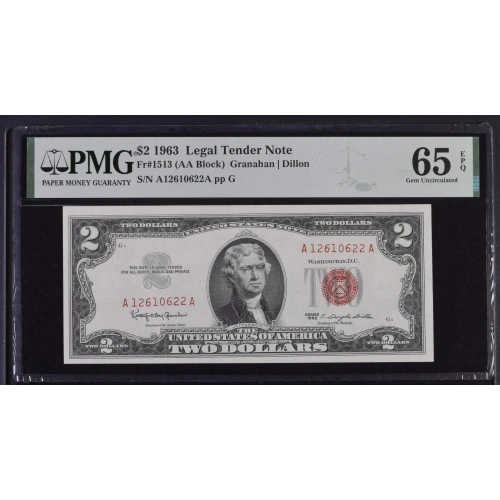
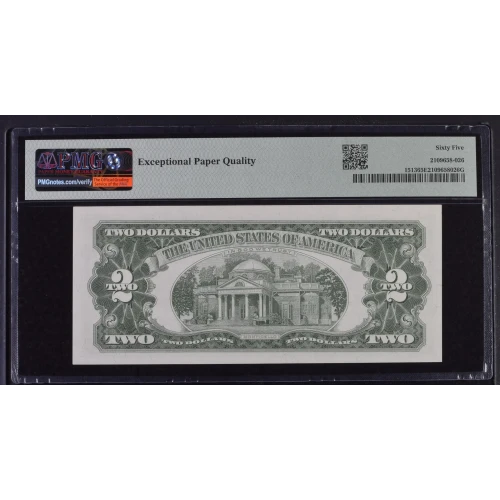
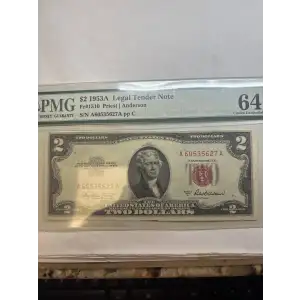
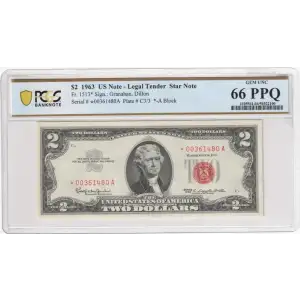
$2 1963 red seal. Small Legal Tender Notes 1513

1963 $2 United States Legal Tender Note - MS 65 Grade

This exceptional 1963 $2 Legal Tender Note in MS 65 condition represents a significant piece of American numismatic history. Graded by professional currency authenticators, this collectible paper money exemplifies the craftsmanship and historical importance of mid-twentieth-century U.S. currency. Whether you're a seasoned collector of rare paper money or new to the world of currency collecting, this MS 65 graded two-dollar note offers both investment potential and historical significance.

Product Overview

The $2 bill has long been one of the most fascinating and misunderstood denominations in American currency. The 1963 series represents a particularly important year in the evolution of U.S. paper money design and production. This MS 65 graded example showcases the note in near-perfect condition, displaying only minor imperfections visible under magnification. The pristine state of this legal tender note makes it a standout acquisition for discerning collectors.

Historical Significance of the $2 Note

The two-dollar bill holds a unique place in American currency history. While many people believe the $2 note is no longer produced, it remains in production today, though in limited quantities. This 1963 example predates the modern era of $2 bill production and represents a critical period in the note's history when production was either halted or severely limited, making these notes increasingly scarce and valuable to collectors.

Key Historical Points:

  • Production Era (1862-1966): The $2 bills printed during this period represent the classic era of two-dollar note production. The 1963 series falls within this important timeframe when fewer notes were being produced compared to other denominations.
  • 1966 Production Halt: After 1966, the $2 bill was removed from circulation for over a decade. This gap in production makes notes from the early-to-mid 1960s considerably scarcer than those produced afterward.
  • Return to Production (1976): The $2 bill returned to production in 1976 for the United States Bicentennial celebration, but the pre-1976 notes remain more sought-after by collectors.
  • Rarity Factor: The 1963 series is particularly scarce because it was printed near the end of the first production run, before the fourteen-year hiatus.
  • Legal Tender Status: This note retains its full legal tender status and can technically be used as currency, though its collector value far exceeds its face value.

Design and Engraving Details

The 1963 $2 Legal Tender Note features Thomas Jefferson on the obverse (front) side, while the reverse displays the Declaration of Independence engraving. This iconic imagery has remained consistent throughout most of the $2 bill's production history, making the design instantly recognizable to currency enthusiasts and historians alike.

The engraving quality of the 1963 series reflects the high standards of the Bureau of Engraving and Printing during this era. The fine lines, intricate details, and security features demonstrate the sophisticated anti-counterfeiting measures that were implemented during the 1960s. Examining this MS 65 graded note under magnification reveals the exceptional quality of the original engraving work.

Grading and Condition - MS 65 Explanation

Understanding the Sheldon grading scale is essential for paper money collectors. The MS 65 grade, also known as "Gem Uncirculated," represents an exceptionally high quality standard for collectible currency. This grading indicates that the note has never been in general circulation and shows only minimal signs of handling.

MS 65 Condition Characteristics:

  • No folds, tears, or creases visible to the naked eye
  • Bright, original paper with minimal oxidation or discoloration
  • Crisp, well-defined printing with no smudging
  • All design elements sharp and perfectly legible
  • Only light surface wear from careful storage and handling
  • No ink loss, foxing, or significant stains
  • Colors remain vibrant and true to original specifications
  • Minor imperfections visible only under magnification

Why Collect 1963 $2 Bills?

Collectors pursue 1963 $2 notes for numerous compelling reasons. The scarcity of $2 bills from this era creates strong demand among numismatists. Additionally, the historical context of the note—produced during a pivotal moment just before the fourteen-year production gap—adds to its appeal and long-term value potential.

The $2 bill represents an accessible entry point for newcomers to paper money collecting while offering depth and complexity for experienced collectors. Unlike some high-value denominations, quality examples of $2 bills remain available at reasonable price points, making them an excellent value proposition for building a meaningful collection.

Investment Potential and Collectibility

Certified paper money has demonstrated consistent appreciation over time, particularly when the currency is scarce and in excellent condition. The MS 65 grade on this 1963 note provides third-party authentication and establishes a baseline for its condition and value. Professional grading and certification enhance both the desirability and marketability of collectible currency.

The $2 bill market has experienced renewed interest in recent years as more collectors recognize the historical significance and investment potential of these notes. The 1963 series, in particular, benefits from its position at the end of the classic production era.

Authentication and Certification

This $2 note has been professionally graded and encapsulated by recognized currency grading services. The MS 65 designation provides independent verification of the note's authenticity and condition. Certification protects your investment by providing expert authentication and creating a detailed record of the note's characteristics.

When acquiring collectible paper money, always seek professionally graded and certified examples from reputable dealers. Certification ensures that you receive authentic currency in the condition represented and provides confidence in your purchase.

Display and Storage Recommendations

To preserve the condition of your 1963 $2 Legal Tender Note, proper storage is essential. The certified holder provides adequate protection for long-term preservation. When displaying the note, ensure it remains away from direct sunlight, excessive humidity, and temperature fluctuations. The encapsulation protects against environmental contaminants while allowing full visibility of this beautiful example of American currency.

Expand Your Currency Collection

This exceptional 1963 $2 note represents a smart addition to any collection of American currency. Whether you're interested in $2 bills specifically, mid-twentieth-century paper money broadly, or United States currency in general, this MS 65 example offers quality, rarity, and historical significance.

Conclusion

The 1963 $2 Legal Tender Note MS 65 stands as a testament to American numismatic history and the enduring appeal of rare currency. Its exceptional condition, historical importance, and growing collector interest make it a worthwhile addition to any collection. Don't miss the opportunity to acquire this scarce piece of American currency heritage.

Product ID 562199
Series Year 1963
Country United States
Denomination $2
Grading Agency PMG
Grade 65 EPQ
Signature Granahan Dillon
Category Small Legal Tender Notes
Serial No A12610622A
Status Active
Seal Red
Fr / Pick # 1513
Additional Info No Printed: 15360000

You must be authenticated to write reviews. Click here   to login.

There are no reviews yet. Be the first to write one!

$2 1963 Legal Tender Note MS 65

+

Description

1963 $2 United States Legal Tender Note - MS 65 Grade

This exceptional 1963 $2 Legal Tender Note in MS 65 condition represents a significant piece of American numismatic history. Graded by professional currency authenticators, this collectible paper money exemplifies the craftsmanship and historical importance of mid-twentieth-century U.S. currency. Whether you're a seasoned collector of rare paper money or new to the world of currency collecting, this MS 65 graded two-dollar note offers both investment potential and historical significance.

Product Overview

The $2 bill has long been one of the most fascinating and misunderstood denominations in American currency. The 1963 series represents a particularly important year in the evolution of U.S. paper money design and production. This MS 65 graded example showcases the note in near-perfect condition, displaying only minor imperfections visible under magnification. The pristine state of this legal tender note makes it a standout acquisition for discerning collectors.

Historical Significance of the $2 Note

The two-dollar bill holds a unique place in American currency history. While many people believe the $2 note is no longer produced, it remains in production today, though in limited quantities. This 1963 example predates the modern era of $2 bill production and represents a critical period in the note's history when production was either halted or severely limited, making these notes increasingly scarce and valuable to collectors.

Key Historical Points:

  • Production Era (1862-1966): The $2 bills printed during this period represent the classic era of two-dollar note production. The 1963 series falls within this important timeframe when fewer notes were being produced compared to other denominations.
  • 1966 Production Halt: After 1966, the $2 bill was removed from circulation for over a decade. This gap in production makes notes from the early-to-mid 1960s considerably scarcer than those produced afterward.
  • Return to Production (1976): The $2 bill returned to production in 1976 for the United States Bicentennial celebration, but the pre-1976 notes remain more sought-after by collectors.
  • Rarity Factor: The 1963 series is particularly scarce because it was printed near the end of the first production run, before the fourteen-year hiatus.
  • Legal Tender Status: This note retains its full legal tender status and can technically be used as currency, though its collector value far exceeds its face value.

Design and Engraving Details

The 1963 $2 Legal Tender Note features Thomas Jefferson on the obverse (front) side, while the reverse displays the Declaration of Independence engraving. This iconic imagery has remained consistent throughout most of the $2 bill's production history, making the design instantly recognizable to currency enthusiasts and historians alike.

The engraving quality of the 1963 series reflects the high standards of the Bureau of Engraving and Printing during this era. The fine lines, intricate details, and security features demonstrate the sophisticated anti-counterfeiting measures that were implemented during the 1960s. Examining this MS 65 graded note under magnification reveals the exceptional quality of the original engraving work.

Grading and Condition - MS 65 Explanation

Understanding the Sheldon grading scale is essential for paper money collectors. The MS 65 grade, also known as "Gem Uncirculated," represents an exceptionally high quality standard for collectible currency. This grading indicates that the note has never been in general circulation and shows only minimal signs of handling.

MS 65 Condition Characteristics:

  • No folds, tears, or creases visible to the naked eye
  • Bright, original paper with minimal oxidation or discoloration
  • Crisp, well-defined printing with no smudging
  • All design elements sharp and perfectly legible
  • Only light surface wear from careful storage and handling
  • No ink loss, foxing, or significant stains
  • Colors remain vibrant and true to original specifications
  • Minor imperfections visible only under magnification

Why Collect 1963 $2 Bills?

Collectors pursue 1963 $2 notes for numerous compelling reasons. The scarcity of $2 bills from this era creates strong demand among numismatists. Additionally, the historical context of the note—produced during a pivotal moment just before the fourteen-year production gap—adds to its appeal and long-term value potential.

The $2 bill represents an accessible entry point for newcomers to paper money collecting while offering depth and complexity for experienced collectors. Unlike some high-value denominations, quality examples of $2 bills remain available at reasonable price points, making them an excellent value proposition for building a meaningful collection.

Investment Potential and Collectibility

Certified paper money has demonstrated consistent appreciation over time, particularly when the currency is scarce and in excellent condition. The MS 65 grade on this 1963 note provides third-party authentication and establishes a baseline for its condition and value. Professional grading and certification enhance both the desirability and marketability of collectible currency.

The $2 bill market has experienced renewed interest in recent years as more collectors recognize the historical significance and investment potential of these notes. The 1963 series, in particular, benefits from its position at the end of the classic production era.

Authentication and Certification

This $2 note has been professionally graded and encapsulated by recognized currency grading services. The MS 65 designation provides independent verification of the note's authenticity and condition. Certification protects your investment by providing expert authentication and creating a detailed record of the note's characteristics.

When acquiring collectible paper money, always seek professionally graded and certified examples from reputable dealers. Certification ensures that you receive authentic currency in the condition represented and provides confidence in your purchase.

Display and Storage Recommendations

To preserve the condition of your 1963 $2 Legal Tender Note, proper storage is essential. The certified holder provides adequate protection for long-term preservation. When displaying the note, ensure it remains away from direct sunlight, excessive humidity, and temperature fluctuations. The encapsulation protects against environmental contaminants while allowing full visibility of this beautiful example of American currency.

Expand Your Currency Collection

This exceptional 1963 $2 note represents a smart addition to any collection of American currency. Whether you're interested in $2 bills specifically, mid-twentieth-century paper money broadly, or United States currency in general, this MS 65 example offers quality, rarity, and historical significance.

Conclusion

The 1963 $2 Legal Tender Note MS 65 stands as a testament to American numismatic history and the enduring appeal of rare currency. Its exceptional condition, historical importance, and growing collector interest make it a worthwhile addition to any collection. Don't miss the opportunity to acquire this scarce piece of American currency heritage.

Specifications

Secure Transactions
Safeguarding Your Investments/Passion in Coins, Currency, or Bullion
We Buy Estates
We buy in-whole or in-part estates in 7 a state area.
Cash for Gold
Convert unwanted jewelry to cash or bullion
Your Cart


Continue to Checkout