- Gold Au $4380.38 $0.00
- Silver Ag $66.41 $0.00
- Platinum Pt $1817.59 $0.36
- Palladium Pd $1335.44 $0.00
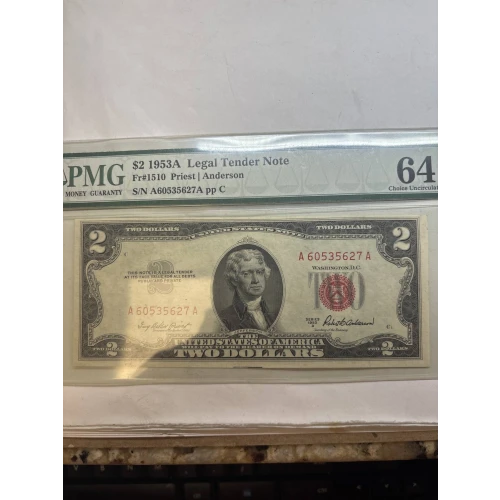
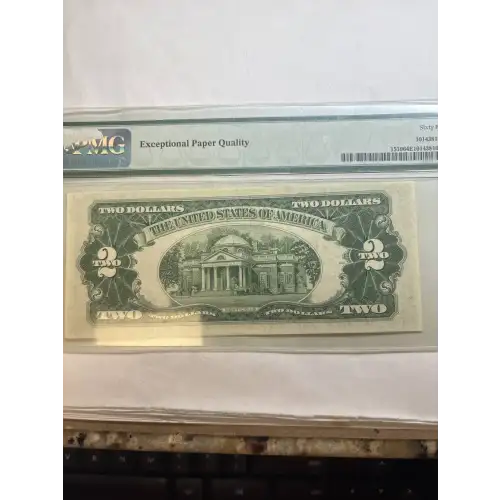
$2 1953 A Legal Tender Note MS 64
Description
The $2 1953 A Legal Tender Note MS 64 represents a remarkable piece of American currency history. This exceptional collectible paper money showcases the artistry and numismatic significance of mid-20th century United States currency. Graded MS 64 by professional numismatic standards, this note demonstrates outstanding preservation and aesthetic appeal that appeals to both seasoned collectors and newcomers to the hobby of currency collecting.
Overview of the 1953 A $2 Note
The $2 Legal Tender Note from 1953 with the "A" series designation is a sought-after addition to any serious currency collection. This particular note represents a specific printing during the post-World War II era when the U.S. Bureau of Engraving and Printing was actively producing currency to meet the nation's monetary needs. The MS 64 grade indicates that this note has been professionally authenticated and graded for its exceptional condition, preservation quality, and visual appeal.
Historical Significance and Production
The year 1953 marks an important period in American monetary history. Following the conclusion of World War II, the United States economy was experiencing significant growth and expansion. Currency production resumed at full capacity to support this economic activity. The $2 note, in particular, has always held a special place in American numismatics due to its lower circulation rates compared to other denominations.
The 1953 A series designation indicates this note was part of a specific printing run that occurred during that fiscal year. The "A" suffix helps numismatists and collectors identify the exact series and timeline of production. This level of specificity is crucial for building comprehensive collections organized by series and date.
The $2 Note: America's Underappreciated Currency
Despite being legal tender since 1862, the $2 note has maintained relatively low circulation throughout American history. This limited circulation is one of the primary reasons why $2 notes remain so collectible today. Many Americans have never held a $2 bill, contributing to their mystique and value among collectors. The 1953 A $2 note exemplifies this rarity, as these notes have largely been removed from general circulation over the decades.
The $2 note features Thomas Jefferson on the obverse (front) and an engraving of the Declaration of Independence on the reverse (back). This iconic imagery makes the note not only a valuable collectible but also a significant piece of American heritage and patriotic symbolism. The artistic quality and historical importance of the design elements contribute substantially to the note's appeal among collectors.
Grading and Condition: Understanding MS 64
The MS 64 grade is a crucial factor in determining the value and desirability of this collectible. MS stands for "Mint State," indicating that the note has never circulated in commerce. The numerical grade of 64 on the 70-point Sheldon scale represents a note in exceptional condition with only minor imperfections visible under close examination.
An MS 64 graded note displays crisp, well-defined printing with vibrant ink colors that have remained largely unchanged since production. The paper exhibits minimal evidence of handling, storage wear, or age-related degradation. The margins are typically well-preserved, and the centering of the design elements is excellent. While not quite perfect enough for the highest grades (MS 65 or higher), an MS 64 note still represents outstanding preservation worthy of display and collection.
Professional grading services employ rigorous standards to ensure consistency and accuracy. Multiple expert examiners evaluate each note for numerous factors including paper quality, print clarity, color vibrancy, margin condition, and any signs of damage or restoration. This professional authentication adds significant value and credibility to collectible currency.
Collectibility and Market Value
Collectible paper money has become an increasingly popular alternative investment and hobby. Unlike typical circulating currency, notes like the 1953 A $2 Legal Tender Note in MS 64 condition maintain and often appreciate in value. Collectors appreciate the tangible nature of paper currency, its historical significance, and the relatively accessible entry point for beginning numismatists.
The $2 note, in particular, commands premium prices in quality grades. Collectors actively seek out examples from different series and years to complete their collections. The 1953 A series occupies an important position in the timeline of $2 note production, making specimens in high grades particularly desirable.
Key Historical Timeline
- 1862: The $2 Legal Tender Note was first issued by the United States government
- 1862-1966: Era of continuous $2 note production with periodic design changes
- 1953: Year of this particular note's production during post-WWII economic growth
- 1953 A Series: The specific printing run designation for this collectible
- 1966-1976: Period when $2 note production was halted
- 1976-Present: Resume of $2 note production, though at much lower volumes than other denominations
Design Elements and Artistic Features
The aesthetic quality of the 1953 A $2 note reflects the exceptional craftsmanship of American currency design. The portrait of Thomas Jefferson is rendered with remarkable detail and dignity, capturing the founding father's likeness with historical accuracy. The engraving techniques employed by the Bureau of Engraving and Printing were state-of-the-art for the era, resulting in fine line work and subtle gradations that remain impressive even in the 21st century.
The reverse side features John Trumbull's historical painting of the Declaration of Independence. This iconic image has adorned the $2 note for over a century, making it one of the most recognizable currency designs in American history. The intricate engraving of this complex scene demonstrates the technical expertise of the Bureau's artisans.
The security features and printing techniques employed in the 1953 era represented the cutting edge of anti-counterfeiting technology. Color gradations, fine-line patterns, and specialized inks were carefully selected to prevent unauthorized reproduction. These design elements contribute to both the historical and aesthetic value of the note.
Why Collectors Seek 1953 A $2 Notes
Numismatists and paper money enthusiasts target notes from the 1953 series for several compelling reasons. The post-war period represents a significant era in American economic and cultural history. Collecting notes from this period allows collectors to hold tangible pieces of American heritage from a transformative era.
The combination of historical significance, low circulation rates, and the $2 note's inherent rarity makes the 1953 A series particularly valuable. Collectors often focus on assembling complete series sets, and obtaining quality examples of each year and series designation becomes a engaging pursuit.
The MS 64 grade represents an ideal balance for many collectors between exceptional condition and reasonable value. While higher grades command premium prices, MS 64 examples remain accessible to serious collectors while still representing truly outstanding preservation.
Storage and Preservation
Maintaining the condition of a valuable collectible like the 1953 A $2 Legal Tender Note requires appropriate storage and handling. Professional collectors utilize archival-quality holders and storage materials to protect their investments from environmental damage, UV exposure, and physical deterioration.
The MS 64 grade achieved by this note reflects decades of proper care and storage. Collectors who acquire such pieces should continue following best practices for preservation, including minimizing handling, storing in climate-controlled environments, and utilizing certified holders.
Investment Potential
Beyond the intrinsic appeal to history enthusiasts, collectible currency represents a legitimate investment vehicle. The $2 note market has demonstrated consistent strength, with quality examples appreciating over time. The combination of numismatic scarcity, historical significance, and limited supply creates favorable conditions for value appreciation.
The 1953 A $2 Legal Tender Note in MS 64 condition represents a particularly strong investment opportunity within the paper money market. As fewer pristine examples remain in existence, those that have been professionally preserved and graded become increasingly valuable to collectors.
Authentication and Certification
The professional grading and authentication of this note provides confidence and peace of mind to potential purchasers. Reputable grading services employ rigorous standards and examination procedures to ensure accuracy. The encapsulation of the note in a certified holder provides both protection and verification of its grade and authenticity.
This authentication is particularly important in the paper money market, where counterfeit examples occasionally appear. A professionally graded and certified note eliminates concerns about authenticity while providing a clear record of the item's condition and value.
The Enduring Appeal of Paper Money Collecting
The hobby of paper money collecting continues to attract enthusiasts of all ages and backgrounds. Unlike other forms of collecting, currency provides unique advantages including historical documentation, artistic merit, and relatively easy preservation. Each note tells a story about the era in which it was produced and the people it circulated among.
The $2 note, with its limited circulation and historical significance, occupies a special niche within numismatics. Collectors appreciate the unique challenge of assembling complete sets and the satisfaction of owning rare examples in exceptional condition.
Conclusion
The $2 1953 A Legal Tender Note MS 64 represents an exceptional opportunity for collectors to acquire a significant piece of American monetary history in outstanding condition. The combination of historical importance, artistic merit, rarity, and exceptional preservation makes this collectible paper money a valuable addition to any serious collection. Whether you are an established numismatist or beginning your journey into currency collecting, this 1953 A $2 note offers both tangible value and the enduring satisfaction of owning a genuine piece of American heritage.
Specifications
Related products