- Gold Au $4352.50 $0.00
- Silver Ag $64.76 $0.00
- Platinum Pt $1816.60 $0.00
- Palladium Pd $1338.00 $0.00
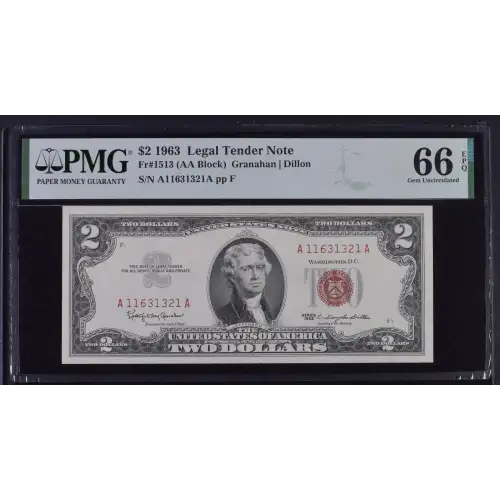
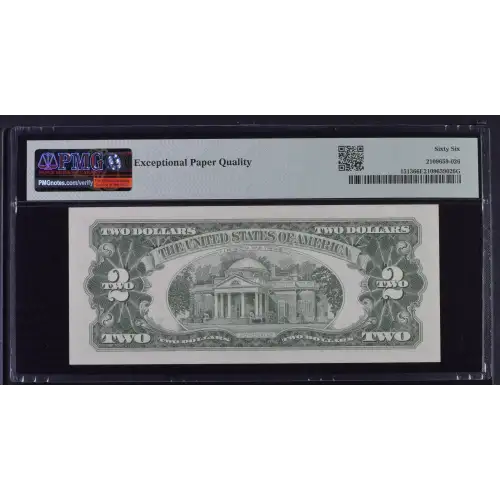
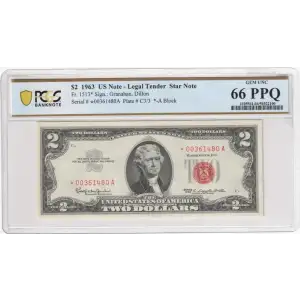
$2 1963 Legal Tender Note MS 66
Description
The $2 1963 Legal Tender Note MS 66 is a remarkable piece of American currency history and a highly sought-after collectible for numismatists and history enthusiasts. This exceptional specimen in Mint State 66 condition represents one of the most intriguing denominations ever produced by the United States Bureau of Engraving and Printing. Whether you're a seasoned collector or just beginning your journey into rare currency, this $2 bill from 1963 offers both historical significance and investment potential.
Understanding the $2 1963 Legal Tender Note
The $2 bill holds a unique place in American monetary history. Often overlooked and frequently hoarded by collectors, these notes represent a fascinating chapter in the evolution of U.S. currency design and production. The 1963 series specifically marks an important transitional period in American paper money, making it an essential addition to any serious collection.
This particular note has been professionally graded and certified as MS 66 (Mint State 66), indicating exceptional quality and preservation. The MS 66 grade means the note displays virtually no signs of wear or handling, with bright colors, crisp paper, and clear details throughout. This high grade commands significant premium value among collectors who understand the rarity and desirability of well-preserved specimens.
Historical Background of the $2 Bill
- Original Production: The $2 bill was first issued in 1862 by the United States government as a Legal Tender Note
- The Thomas Jefferson Connection: The $2 bill features Thomas Jefferson on the obverse (front) and the Declaration of Independence on the reverse (back)
- Production Challenges: Due to lack of public demand and collector interest, $2 bills have experienced intermittent production throughout American history
- 1963 Series Significance: The 1963 date series represents the post-World War II era of American currency design and printing technology
- Modern Rarity: Many $2 bills from the 1960s were removed from circulation and stored, making quality examples relatively scarce in the numismatic market
The 1963 Production Era
The year 1963 was a pivotal moment in American history and currency production. This was the final year that $2 Legal Tender Notes were actively printed in significant quantities before a long hiatus in production. The 1963 series represents the end of an era, making any well-preserved example from this year particularly valuable to collectors focused on completing their sets of $2 bill series.
During this period, the Bureau of Engraving and Printing was utilizing refined printing techniques that had been perfected over decades. The 1963 $2 bills showcase excellent clarity and detail work, with vibrant ink colors and precisely aligned designs. The paper quality and construction methods used in 1963 were among the finest in the history of U.S. currency production, contributing to the excellent condition status of surviving examples like this MS 66 specimen.
Why the $2 Bill Remains Collectible
The $2 bill occupies a special niche in numismatic circles. While not produced in every year, these notes have a dedicated following of collectors who appreciate their uniqueness and historical importance. The 1963 date is particularly sought after because it marks the conclusion of an era and represents the last significant production run of $2 Legal Tender Notes for many years.
Collectors value $2 bills for several important reasons. First, they are genuinely scarce compared to other denominations, as most were either kept as curiosities or destroyed over time. Second, they feature outstanding artistic designs that showcase the skill of currency engravers. Third, they represent a tangible connection to American history and the evolution of the nation's monetary system. Fourth, high-grade examples like this MS 66 specimen continue to appreciate as more notes are damaged or removed from potential collecting circulation.
Understanding the MS 66 Grade
The Mint State 66 grade is a prestigious designation in the world of paper money grading. Using a numerical scale where MS 70 represents perfect condition, an MS 66 note is considered to be in superb condition with only the most minimal imperfections visible under careful examination.
An MS 66 graded $2 bill will exhibit the following characteristics:
- Bright, vibrant colors with no fading or discoloration
- Crisp, clean paper with excellent structural integrity
- Sharp, well-defined printing throughout the note
- No visible evidence of handling, creasing, or wear
- Perfectly centered design elements
- Clear, legible serial numbers and text
- Strong ink saturation with no bleeding or smudging
This exceptional level of preservation is what distinguishes truly valuable collectible notes from common circulated specimens. When a note achieves MS 66 status, it represents the survival of the original intent—that this piece of currency be preserved as a work of art and a historical artifact.
Production and Rarity Information
The 1963 series $2 Legal Tender Notes were produced by the Bureau of Engraving and Printing at their facilities, with production numbers that were relatively modest compared to higher denominations. The fact that we can discuss the rarity of this note more than 60 years later speaks to how few examples have survived in premium condition.
Many 1963 $2 bills were immediately removed from circulation upon receipt by banks, as the public showed little interest in using these notes for everyday transactions. This unusual behavior actually benefited collectors, as it meant many were stored away rather than worn through handling. However, storage conditions varied dramatically, and notes that experienced poor storage may show signs of aging, discoloration, or environmental damage.
Investment Potential and Value Considerations
Collectors and investors have long recognized the value potential of rare and scarce currency. High-grade $2 bills represent an interesting alternative to traditional bullion investments. While silver and gold prices fluctuate based on commodity markets, the value of rare currency depends on scarcity, condition, and collector demand.
The MS 66 grade for a 1963 $2 bill places it in the upper echelon of available specimens. As more notes are removed from collections, discovered and graded, or damaged over time, the remaining high-grade examples tend to appreciate. This $2 bill represents a tangible piece of history with enduring collector appeal that transcends simple monetary value.
Display and Preservation Recommendations
If you acquire this $2 1963 Legal Tender Note MS 66, proper preservation becomes essential. The note is already professionally graded and encapsulated by certified grading services, which provides excellent protection against environmental damage, handling marks, and deterioration.
For display purposes, consider these recommendations:
- Keep the note in its professional grading holder to maintain condition and certification
- Store in a climate-controlled environment away from direct sunlight
- Maintain stable temperature and humidity levels to prevent paper degradation
- Display in a shadow box or framed presentation that protects while showcasing the note
- Avoid touching the note with bare hands; use cotton gloves if handling is necessary
- Keep away from moisture, extreme temperatures, and potentially damaging substances
Completing Your Currency Collection
Whether you're completing a series of $2 bills, assembling a collection of 1963-dated currency, or seeking rare Legal Tender Notes, this specimen offers exceptional value. The combination of the scarce 1963 date, the collectible $2 denomination, and the superb MS 66 grade makes this a note that appeals to multiple collector interests.
Many collectors focus specifically on acquiring examples from key years in $2 production. The 1963 series stands out as one of these key years, marking the final chapter before production ceased for an extended period. Adding this note to your collection means owning a piece of a critical historical moment in American currency production.
The Lasting Appeal of American Currency
Numismatics—the study and collection of coins and currency—has engaged collectors for centuries. American paper money offers a unique opportunity to own pieces that are simultaneously artistic works, historical documents, and financial instruments. The $2 bill, in particular, remains enigmatic and fascinating to collectors around the world.
This $2 1963 Legal Tender Note MS 66 represents an outstanding opportunity to own a significant piece of American numismatic history in exceptional condition. The professional grading certification provides confidence in the note's authenticity and condition, while the rarity and collectibility ensure long-term value. Whether acquired for a specialized collection, as an investment, or simply as an appreciation for American heritage and craftsmanship, this note delivers on all fronts.
Conclusion
The $2 1963 Legal Tender Note MS 66 is more than just currency—it's a window into American history, a testament to the artistry of currency design, and a tangible investment in numismatic excellence. Its exceptional grade, scarce date, and the inherent rarity of the $2 denomination combine to make this a must-have item for serious collectors. Don't miss the opportunity to add this remarkable piece to your collection today.
Specifications
Related products