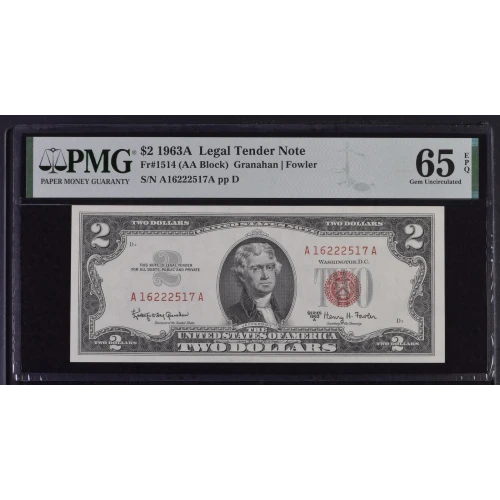
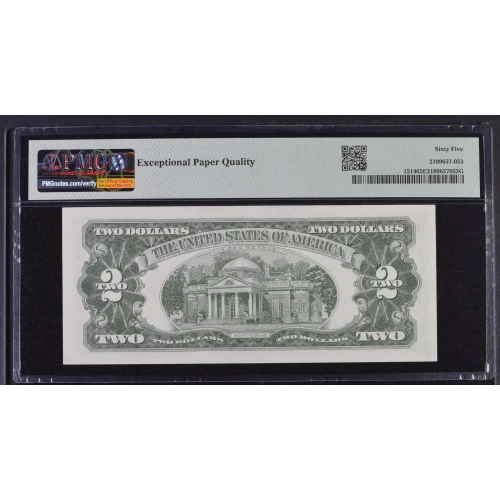
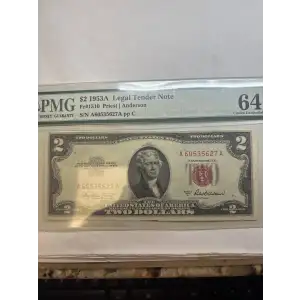
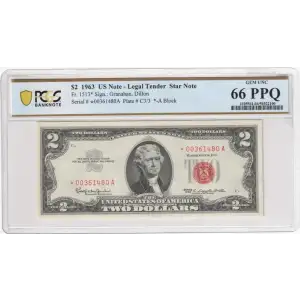
$2 1963-A red seal. Small Legal Tender Notes 1514

Discover the historical significance and numismatic value of the $2 1963 A Legal Tender Note MS65, a remarkable piece of American currency that represents an important era in U.S. monetary history. This collectible two-dollar bill is graded MS65 by professional numismatic standards, indicating exceptional condition with only minimal imperfections. Whether you're an experienced collector or just beginning your journey into paper money collecting, this 1963 A series note offers both historical charm and investment potential.

About the $2 Legal Tender Note

The two-dollar bill holds a unique place in American currency history. While many people believe the $2 bill is no longer in production, this is actually a misconception. However, the vintage 1963 A Legal Tender Note represents a significant period in the evolution of U.S. paper currency. The $2 bill has been printed intermittently throughout American history, with production varying based on demand and economic conditions.

This particular 1963 A series note features the iconic portrait of Thomas Jefferson, one of America's founding fathers and the third President of the United States. The reverse side displays the famous engraving of the signing of the Declaration of Independence, a design that has captivated collectors and history enthusiasts for generations.

Historical Background and Production Years

  • Year Printed: 1963 (Series A designation)
  • Denomination: $2 United States Legal Tender Note
  • Portrait: Thomas Jefferson
  • Reverse Design: The Signing of the Declaration of Independence
  • Condition Grade: MS65 (Mint State 65)
  • Rarity Factor: Relatively scarce in high grades

The History of Two-Dollar Bills

The history of the $2 bill in the United States is fascinating and complex. The first two-dollar notes were issued as Legal Tender Notes in 1862, making them one of the earliest denominations printed by the U.S. government. Throughout the 19th and 20th centuries, the $2 bill has experienced periods of popularity and relative obscurity.

During the early 1900s, the $2 denomination fell out of favor, and production was halted in 1966 due to lack of public demand. This decision made the bills printed before this cutoff, including your 1963 A series note, increasingly collectible. The $2 bill was reintroduced in 1976 for the United States Bicentennial celebration, but the vintage notes from the 1960s remain highly sought after by collectors.

The 1963 series represents a transitional period in American currency design. This was during the era before the Federal Reserve implemented significant security features to combat counterfeiting. The 1963 A Legal Tender Note showcases the classic design aesthetic that defined mid-20th century American paper currency.

MS65 Condition Grade: What Does It Mean?

The MS65 grade is a significant designation in the world of collectible paper money grading. MS stands for "Mint State," indicating that the note has never been in circulation. The numerical grade of 65 on a scale of 1-70 means this note displays exceptional quality with only light signs of aging or handling.

A note graded MS65 may exhibit the following characteristics:

  • Bright and vibrant color with excellent ink quality
  • Sharp, well-defined printing and detail work
  • Minimal wear or creasing visible to the naked eye
  • Excellent centering of the design within the note borders
  • Only light signs of aging such as minor foxing or slight discoloration
  • Strong paper quality with no major folds or tears

Notes in MS65 condition are considerably rarer and more valuable than lower grades, making this an excellent specimen for serious collectors seeking quality examples of vintage American currency.

Design Elements and Distinguishing Features

The obverse (front) side of this $2 note features a portrait of Thomas Jefferson, positioned in the center of the bill. Jefferson's likeness has appeared on the $2 bill since 1862, making it one of the longest-running portrait associations in American currency history.

The reverse (back) side showcases one of the most iconic American images: the signing of the Declaration of Independence. This engraving depicts the moment when the founding fathers approved this pivotal document on July 4, 1776. The detailed artwork captures the solemnity and historic importance of this event.

The 1963 A series designation indicates this note was printed during the first series of that year. Series letters help collectors identify different printings and variations within specific years, adding another layer of interest to your collection.

Collecting $2 Bills: Why They Matter

Collecting vintage $2 notes has become increasingly popular among numismatists and history enthusiasts. These bills offer several advantages to collectors:

  • Historical Significance: Each note represents a specific period in American monetary policy and design evolution
  • Affordable Entry Point: Compared to rare coins, $2 bills offer accessible collecting opportunities
  • Aesthetic Appeal: The classic designs and artistic engraving make these notes visually stunning
  • Educational Value: Learning about currency history provides insights into American culture and economics
  • Investment Potential: Rare grades of vintage notes appreciate over time

Why 1963 A Series Notes Are Collectible

The 1963 A series occupies an important position in $2 bill collecting. As a pre-1966 cutoff note, it belongs to a group of bills that are no longer being produced in large quantities. This rarity factor has made 1963 A series notes increasingly sought after by collectors.

Additionally, the MS65 grade represents a superior condition that significantly enhances collectibility. High-grade examples of these vintage notes are scarcer than you might expect, as most circulated extensively before being removed from circulation and preserved.

How to Care for Your Collectible Note

Proper storage and handling are essential to maintain the condition and value of your $2 1963 A Legal Tender Note MS65. Consider these preservation guidelines:

  • Store notes in acid-free holders or protective sleeves
  • Keep notes in a cool, dry environment away from direct sunlight
  • Avoid handling notes with bare hands; wear cotton gloves if handling is necessary
  • Store collections in a secure location protected from theft and environmental damage
  • Maintain stable temperature and humidity levels to prevent deterioration

Adding to Your Collection

Whether you're focusing on collecting $2 bills specifically, building a comprehensive U.S. paper money collection, or seeking historically significant artifacts, the $2 1963 A Legal Tender Note MS65 is an excellent addition. This note bridges the gap between affordable collecting and serious numismatic interest.

The combination of historical importance, attractive design, scarce high-grade availability, and reasonable pricing makes this a wise choice for collectors at any level. As time passes and these notes continue to age, high-grade examples like MS65 specimens become increasingly difficult to locate.

Authentication and Grading

The MS65 grade designation comes from professional numismatic grading services that employ rigorous standards to evaluate paper money. Graders examine notes under controlled lighting conditions, using magnification when necessary, to assess condition, eye appeal, and rarity.

Professional grading provides confidence in the note's authenticity and condition grade. An MS65 grade represents the consensus of experienced experts in the field, adding credibility to your investment and collection.

Conclusion

The $2 1963 A Legal Tender Note MS65 represents an outstanding opportunity to own a piece of American monetary history. With its iconic design, historical significance, scarce high-grade availability, and strong collector appeal, this vintage two-dollar bill deserves a place in any serious collection.

Don't miss the chance to acquire this exceptional specimen. High-grade examples of 1963 A series notes continue to appreciate as collectors recognize their rarity and historical importance. Add this beautiful and historically significant piece to your collection today.

Product ID 562198
Series Year 1963A
Country United States
Denomination $2
Grading Agency PMG
Grade 65 EPQ
Signature Granahan Fowler
Category Small Legal Tender Notes
Serial No A16222517A
Status Active
Seal Red
Fr / Pick # 1514
Additional Info No Printed: 3200000

You must be authenticated to write reviews. Click here   to login.

There are no reviews yet. Be the first to write one!

$2 1963 A Legal Tender Note MS65

+

Description

Discover the historical significance and numismatic value of the $2 1963 A Legal Tender Note MS65, a remarkable piece of American currency that represents an important era in U.S. monetary history. This collectible two-dollar bill is graded MS65 by professional numismatic standards, indicating exceptional condition with only minimal imperfections. Whether you're an experienced collector or just beginning your journey into paper money collecting, this 1963 A series note offers both historical charm and investment potential.

About the $2 Legal Tender Note

The two-dollar bill holds a unique place in American currency history. While many people believe the $2 bill is no longer in production, this is actually a misconception. However, the vintage 1963 A Legal Tender Note represents a significant period in the evolution of U.S. paper currency. The $2 bill has been printed intermittently throughout American history, with production varying based on demand and economic conditions.

This particular 1963 A series note features the iconic portrait of Thomas Jefferson, one of America's founding fathers and the third President of the United States. The reverse side displays the famous engraving of the signing of the Declaration of Independence, a design that has captivated collectors and history enthusiasts for generations.

Historical Background and Production Years

  • Year Printed: 1963 (Series A designation)
  • Denomination: $2 United States Legal Tender Note
  • Portrait: Thomas Jefferson
  • Reverse Design: The Signing of the Declaration of Independence
  • Condition Grade: MS65 (Mint State 65)
  • Rarity Factor: Relatively scarce in high grades

The History of Two-Dollar Bills

The history of the $2 bill in the United States is fascinating and complex. The first two-dollar notes were issued as Legal Tender Notes in 1862, making them one of the earliest denominations printed by the U.S. government. Throughout the 19th and 20th centuries, the $2 bill has experienced periods of popularity and relative obscurity.

During the early 1900s, the $2 denomination fell out of favor, and production was halted in 1966 due to lack of public demand. This decision made the bills printed before this cutoff, including your 1963 A series note, increasingly collectible. The $2 bill was reintroduced in 1976 for the United States Bicentennial celebration, but the vintage notes from the 1960s remain highly sought after by collectors.

The 1963 series represents a transitional period in American currency design. This was during the era before the Federal Reserve implemented significant security features to combat counterfeiting. The 1963 A Legal Tender Note showcases the classic design aesthetic that defined mid-20th century American paper currency.

MS65 Condition Grade: What Does It Mean?

The MS65 grade is a significant designation in the world of collectible paper money grading. MS stands for "Mint State," indicating that the note has never been in circulation. The numerical grade of 65 on a scale of 1-70 means this note displays exceptional quality with only light signs of aging or handling.

A note graded MS65 may exhibit the following characteristics:

  • Bright and vibrant color with excellent ink quality
  • Sharp, well-defined printing and detail work
  • Minimal wear or creasing visible to the naked eye
  • Excellent centering of the design within the note borders
  • Only light signs of aging such as minor foxing or slight discoloration
  • Strong paper quality with no major folds or tears

Notes in MS65 condition are considerably rarer and more valuable than lower grades, making this an excellent specimen for serious collectors seeking quality examples of vintage American currency.

Design Elements and Distinguishing Features

The obverse (front) side of this $2 note features a portrait of Thomas Jefferson, positioned in the center of the bill. Jefferson's likeness has appeared on the $2 bill since 1862, making it one of the longest-running portrait associations in American currency history.

The reverse (back) side showcases one of the most iconic American images: the signing of the Declaration of Independence. This engraving depicts the moment when the founding fathers approved this pivotal document on July 4, 1776. The detailed artwork captures the solemnity and historic importance of this event.

The 1963 A series designation indicates this note was printed during the first series of that year. Series letters help collectors identify different printings and variations within specific years, adding another layer of interest to your collection.

Collecting $2 Bills: Why They Matter

Collecting vintage $2 notes has become increasingly popular among numismatists and history enthusiasts. These bills offer several advantages to collectors:

  • Historical Significance: Each note represents a specific period in American monetary policy and design evolution
  • Affordable Entry Point: Compared to rare coins, $2 bills offer accessible collecting opportunities
  • Aesthetic Appeal: The classic designs and artistic engraving make these notes visually stunning
  • Educational Value: Learning about currency history provides insights into American culture and economics
  • Investment Potential: Rare grades of vintage notes appreciate over time

Why 1963 A Series Notes Are Collectible

The 1963 A series occupies an important position in $2 bill collecting. As a pre-1966 cutoff note, it belongs to a group of bills that are no longer being produced in large quantities. This rarity factor has made 1963 A series notes increasingly sought after by collectors.

Additionally, the MS65 grade represents a superior condition that significantly enhances collectibility. High-grade examples of these vintage notes are scarcer than you might expect, as most circulated extensively before being removed from circulation and preserved.

How to Care for Your Collectible Note

Proper storage and handling are essential to maintain the condition and value of your $2 1963 A Legal Tender Note MS65. Consider these preservation guidelines:

  • Store notes in acid-free holders or protective sleeves
  • Keep notes in a cool, dry environment away from direct sunlight
  • Avoid handling notes with bare hands; wear cotton gloves if handling is necessary
  • Store collections in a secure location protected from theft and environmental damage
  • Maintain stable temperature and humidity levels to prevent deterioration

Adding to Your Collection

Whether you're focusing on collecting $2 bills specifically, building a comprehensive U.S. paper money collection, or seeking historically significant artifacts, the $2 1963 A Legal Tender Note MS65 is an excellent addition. This note bridges the gap between affordable collecting and serious numismatic interest.

The combination of historical importance, attractive design, scarce high-grade availability, and reasonable pricing makes this a wise choice for collectors at any level. As time passes and these notes continue to age, high-grade examples like MS65 specimens become increasingly difficult to locate.

Authentication and Grading

The MS65 grade designation comes from professional numismatic grading services that employ rigorous standards to evaluate paper money. Graders examine notes under controlled lighting conditions, using magnification when necessary, to assess condition, eye appeal, and rarity.

Professional grading provides confidence in the note's authenticity and condition grade. An MS65 grade represents the consensus of experienced experts in the field, adding credibility to your investment and collection.

Conclusion

The $2 1963 A Legal Tender Note MS65 represents an outstanding opportunity to own a piece of American monetary history. With its iconic design, historical significance, scarce high-grade availability, and strong collector appeal, this vintage two-dollar bill deserves a place in any serious collection.

Don't miss the chance to acquire this exceptional specimen. High-grade examples of 1963 A series notes continue to appreciate as collectors recognize their rarity and historical importance. Add this beautiful and historically significant piece to your collection today.

Specifications

Secure Transactions
Safeguarding Your Investments/Passion in Coins, Currency, or Bullion
We Buy Estates
We buy in-whole or in-part estates in 7 a state area.
Cash for Gold
Convert unwanted jewelry to cash or bullion
Your Cart


Continue to Checkout