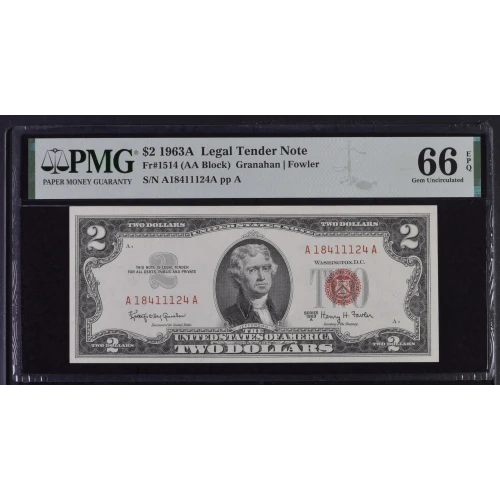
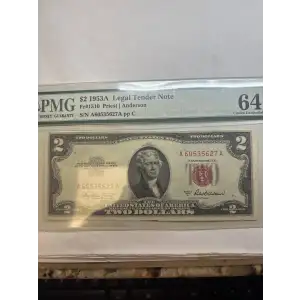
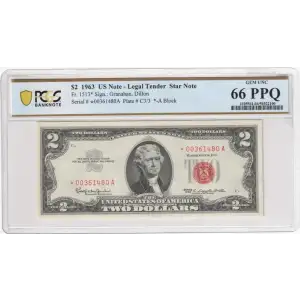
$2 1963-A red seal. Small Legal Tender Notes 1514

The $2 1963 A Legal Tender Note MS 66 is a remarkable piece of American currency history that represents a pivotal moment in U.S. monetary policy. This exceptional collectible paper money specimen showcases the craftsmanship and historical significance of mid-20th century American currency design. With its MS 66 (Mint State) grading, this note represents a high-quality example that appeals to both seasoned numismatists and new collectors alike.

About the $2 Bill: America's Rarest Circulating Currency

The $2 bill holds a unique place in American numismatic history. While many collectors and the general public believe $2 bills are rare or no longer produced, they remain legal tender and continue to be printed today, albeit in limited quantities. The $2 1963 A Legal Tender Note is particularly significant as it represents the classic era of U.S. currency production, when these notes were still relatively more common in circulation.

The "A" designation on this 1963 note indicates a specific printing series, helping collectors identify and categorize these valuable pieces with precision. This particular version is highly sought after by serious collectors who appreciate the historical context and monetary significance of this denomination.

History and Production Timeline

  • Original Introduction: $2 bills were first issued by the United States government in 1862, making them nearly as old as the $1 bill
  • 1963 Series Production: The 1963 A series represents a specific printing run that occurred during a time of significant changes in American currency design and security features
  • Limited Circulation: Even from their original production, $2 bills were printed in much smaller quantities compared to other denominations
  • Modern Rarity: Today, finding $2 bills in circulation is exceptionally rare, making vintage specimens like this 1963 example highly collectible
  • Continuous Production: The Bureau of Engraving and Printing continued producing $2 bills through various series, though production has consistently remained limited

Design and Features of the 1963 $2 Note

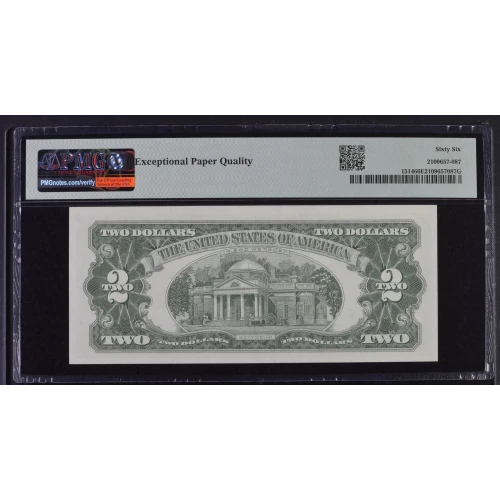
The 1963 $2 Legal Tender Note features the iconic portrait of Thomas Jefferson on the obverse (front) side. Jefferson's image has graced the $2 bill since 1862, making it one of the longest-running designs in American currency history. The reverse (back) side traditionally features an image related to Jefferson's legacy and American history.

The note includes various security features typical of currency from this era, including watermarks, security threads, and distinctive paper composition. These design elements were revolutionary for their time and remain important identifying characteristics for collectors and authenticators.

MS 66 Grading Explained

The MS 66 grading is a crucial factor in determining the value and desirability of this $2 bill. MS 66 stands for "Mint State 66," which is part of the Sheldon Scale grading system used by professional numismatic graders. This grade indicates:

  • Condition: The note exhibits virtually no signs of wear or handling
  • Eye Appeal: The note maintains exceptional visual quality with bright, vibrant coloring
  • Centering: The design is well-centered on the note with appropriate margins
  • Margins and Printing: Clean margins and sharp printing are evident throughout
  • Surface Quality: The paper shows minimal signs of aging or deterioration
  • Rarity Factor: MS 66 grades are relatively uncommon for $2 bills, making them significantly more valuable than lower grades

Finding a $2 bill in MS 66 condition is challenging, as most surviving examples have circulated or been stored in less-than-ideal conditions. This high grade significantly increases both the collectible and monetary value of this specimen.

Why Collect Vintage $2 Bills?

Collecting vintage $2 bills offers numerous advantages for numismatists. These notes represent an important segment of American currency history and showcase the evolution of design and security features throughout the 20th century. The 1963 A series is particularly notable as it bridges the gap between early $2 bill production and modern manufacturing techniques.

For investors and collectors, $2 bills from the 1960s represent an interesting alternative to more commonly collected denominations. While not as universally recognized as their $1 or $100 counterparts, these notes offer unique historical value and collecting opportunities.

Investment and Collectibility

The $2 1963 A Legal Tender Note MS 66 serves as an excellent investment piece for several reasons. The combination of historical significance, relative scarcity, and high grade makes this note attractive to serious collectors. As with all numismatic collectibles, condition and rarity drive value, and this specimen demonstrates both qualities.

The market for vintage $2 bills has remained relatively stable, with collector demand consistently outpacing supply. High-grade examples, particularly those certified by professional grading services, command premium prices in the numismatic market.

Perfect for Collectors and Enthusiasts

Whether you're an experienced numismatist building a comprehensive collection or a newcomer interested in American currency history, the $2 1963 A Legal Tender Note MS 66 offers significant appeal. This piece serves as a tangible connection to American economic history and represents a fascinating era in currency production.

The note's exceptional condition ensures its preservation for future generations while providing immediate enjoyment and investment potential for the current owner. It's a standalone collectible that doesn't require additional pieces to complete a set, making it an ideal acquisition for any collection.

Authenticity and Certification

This $2 1963 A Legal Tender Note has been professionally graded and certified as MS 66, ensuring its authenticity and condition. Professional grading provides peace of mind and serves as documentation of the note's status within the numismatic community. This certification is crucial for both insurance purposes and future resale value.

The grading process involves meticulous examination by experienced professionals who evaluate every aspect of the note. This rigorous assessment ensures that only notes meeting the highest standards receive MS 66 certification.

Historical Context of 1963

The year 1963 marks a significant period in American history. The production of this $2 Legal Tender Note occurred during a time of considerable economic activity and social change in the United States. Currency printed during this era reflects the technological and design standards of the early 1960s, making these notes valuable historical artifacts.

Understanding the historical context adds deeper appreciation to this collectible. The 1963 A series represents an important snapshot of American monetary production during the Cold War era, a time when currency design and production methods were subjects of intense focus and innovation.

Conclusion

The $2 1963 A Legal Tender Note MS 66 represents an exceptional opportunity to own a piece of authentic American currency history. With its combination of historical significance, relative rarity, and exceptional condition grade, this note deserves a place in any serious numismatic collection. Whether acquired for investment purposes, collection completion, or historical appreciation, this 1963 specimen offers lasting value and enjoyment.

Product ID 562196
Series Year 1963A
Country United States
Denomination $2
Grading Agency PMG
Grade 66 EPQ
Signature Granahan Fowler
Category Small Legal Tender Notes
Serial No A18411124A
Status Active
Seal Red
Fr / Pick # 1514
Additional Info No Printed: 3200000

You must be authenticated to write reviews. Click here   to login.

There are no reviews yet. Be the first to write one!

$2 1963 A Legal Tender Note MS 66

+

Description

The $2 1963 A Legal Tender Note MS 66 is a remarkable piece of American currency history that represents a pivotal moment in U.S. monetary policy. This exceptional collectible paper money specimen showcases the craftsmanship and historical significance of mid-20th century American currency design. With its MS 66 (Mint State) grading, this note represents a high-quality example that appeals to both seasoned numismatists and new collectors alike.

About the $2 Bill: America's Rarest Circulating Currency

The $2 bill holds a unique place in American numismatic history. While many collectors and the general public believe $2 bills are rare or no longer produced, they remain legal tender and continue to be printed today, albeit in limited quantities. The $2 1963 A Legal Tender Note is particularly significant as it represents the classic era of U.S. currency production, when these notes were still relatively more common in circulation.

The "A" designation on this 1963 note indicates a specific printing series, helping collectors identify and categorize these valuable pieces with precision. This particular version is highly sought after by serious collectors who appreciate the historical context and monetary significance of this denomination.

History and Production Timeline

  • Original Introduction: $2 bills were first issued by the United States government in 1862, making them nearly as old as the $1 bill
  • 1963 Series Production: The 1963 A series represents a specific printing run that occurred during a time of significant changes in American currency design and security features
  • Limited Circulation: Even from their original production, $2 bills were printed in much smaller quantities compared to other denominations
  • Modern Rarity: Today, finding $2 bills in circulation is exceptionally rare, making vintage specimens like this 1963 example highly collectible
  • Continuous Production: The Bureau of Engraving and Printing continued producing $2 bills through various series, though production has consistently remained limited

Design and Features of the 1963 $2 Note

The 1963 $2 Legal Tender Note features the iconic portrait of Thomas Jefferson on the obverse (front) side. Jefferson's image has graced the $2 bill since 1862, making it one of the longest-running designs in American currency history. The reverse (back) side traditionally features an image related to Jefferson's legacy and American history.

The note includes various security features typical of currency from this era, including watermarks, security threads, and distinctive paper composition. These design elements were revolutionary for their time and remain important identifying characteristics for collectors and authenticators.

MS 66 Grading Explained

The MS 66 grading is a crucial factor in determining the value and desirability of this $2 bill. MS 66 stands for "Mint State 66," which is part of the Sheldon Scale grading system used by professional numismatic graders. This grade indicates:

  • Condition: The note exhibits virtually no signs of wear or handling
  • Eye Appeal: The note maintains exceptional visual quality with bright, vibrant coloring
  • Centering: The design is well-centered on the note with appropriate margins
  • Margins and Printing: Clean margins and sharp printing are evident throughout
  • Surface Quality: The paper shows minimal signs of aging or deterioration
  • Rarity Factor: MS 66 grades are relatively uncommon for $2 bills, making them significantly more valuable than lower grades

Finding a $2 bill in MS 66 condition is challenging, as most surviving examples have circulated or been stored in less-than-ideal conditions. This high grade significantly increases both the collectible and monetary value of this specimen.

Why Collect Vintage $2 Bills?

Collecting vintage $2 bills offers numerous advantages for numismatists. These notes represent an important segment of American currency history and showcase the evolution of design and security features throughout the 20th century. The 1963 A series is particularly notable as it bridges the gap between early $2 bill production and modern manufacturing techniques.

For investors and collectors, $2 bills from the 1960s represent an interesting alternative to more commonly collected denominations. While not as universally recognized as their $1 or $100 counterparts, these notes offer unique historical value and collecting opportunities.

Investment and Collectibility

The $2 1963 A Legal Tender Note MS 66 serves as an excellent investment piece for several reasons. The combination of historical significance, relative scarcity, and high grade makes this note attractive to serious collectors. As with all numismatic collectibles, condition and rarity drive value, and this specimen demonstrates both qualities.

The market for vintage $2 bills has remained relatively stable, with collector demand consistently outpacing supply. High-grade examples, particularly those certified by professional grading services, command premium prices in the numismatic market.

Perfect for Collectors and Enthusiasts

Whether you're an experienced numismatist building a comprehensive collection or a newcomer interested in American currency history, the $2 1963 A Legal Tender Note MS 66 offers significant appeal. This piece serves as a tangible connection to American economic history and represents a fascinating era in currency production.

The note's exceptional condition ensures its preservation for future generations while providing immediate enjoyment and investment potential for the current owner. It's a standalone collectible that doesn't require additional pieces to complete a set, making it an ideal acquisition for any collection.

Authenticity and Certification

This $2 1963 A Legal Tender Note has been professionally graded and certified as MS 66, ensuring its authenticity and condition. Professional grading provides peace of mind and serves as documentation of the note's status within the numismatic community. This certification is crucial for both insurance purposes and future resale value.

The grading process involves meticulous examination by experienced professionals who evaluate every aspect of the note. This rigorous assessment ensures that only notes meeting the highest standards receive MS 66 certification.

Historical Context of 1963

The year 1963 marks a significant period in American history. The production of this $2 Legal Tender Note occurred during a time of considerable economic activity and social change in the United States. Currency printed during this era reflects the technological and design standards of the early 1960s, making these notes valuable historical artifacts.

Understanding the historical context adds deeper appreciation to this collectible. The 1963 A series represents an important snapshot of American monetary production during the Cold War era, a time when currency design and production methods were subjects of intense focus and innovation.

Conclusion

The $2 1963 A Legal Tender Note MS 66 represents an exceptional opportunity to own a piece of authentic American currency history. With its combination of historical significance, relative rarity, and exceptional condition grade, this note deserves a place in any serious numismatic collection. Whether acquired for investment purposes, collection completion, or historical appreciation, this 1963 specimen offers lasting value and enjoyment.

Specifications

Secure Transactions
Safeguarding Your Investments/Passion in Coins, Currency, or Bullion
We Buy Estates
We buy in-whole or in-part estates in 7 a state area.
Cash for Gold
Convert unwanted jewelry to cash or bullion
Your Cart


Continue to Checkout