- Gold Au $4193.70 $-0.84
- Silver Ag $65.30 $-0.01
- Q Platinum1 Pt $1696.50 $-0.17
- Q Palladium1 Pd $1300.00 $0.00
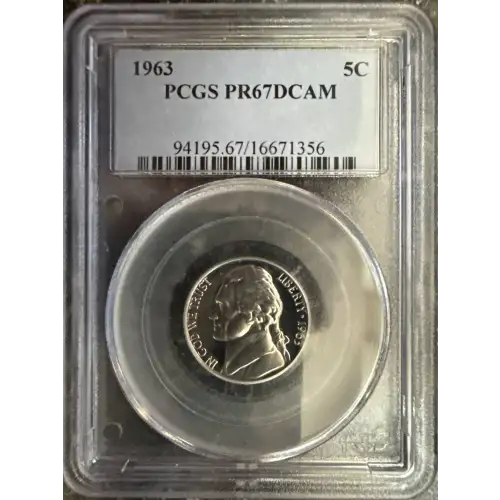
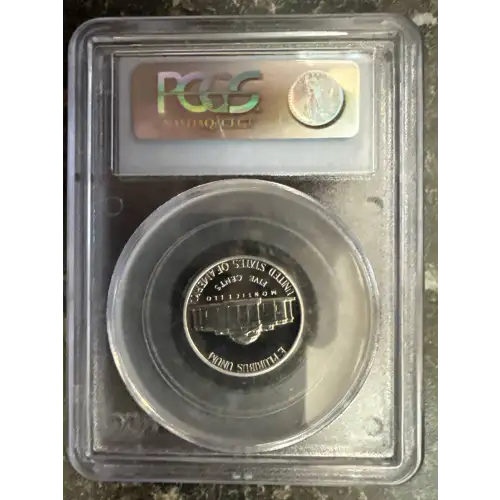
1963 Jefferson Nickel PCGS PR-67 DCAM
Category: Jefferson NickelDescription
1963 P Jefferson Nickel PCGS PR-67 DCAM - Exceptional American Proof Coin
The 1963 P Jefferson Nickel PCGS PR-67 DCAM represents one of the most sought-after proof coins from the early post-war era of American numismatic coinage. This stunning specimen exemplifies the artistry and precision of the United States Mint's proof production process during the height of the Kennedy administration. With its deep cameo contrast and exceptional eye appeal, this coin stands as a testament to mid-20th century minting excellence and remains highly coveted by serious collectors and numismatic enthusiasts worldwide.
Product Specifications
- Coin Type: Jefferson Nickel (Five-Cent Piece)
- Year of Issue: 1963
- Mint Mark: P (Philadelphia Mint)
- Denomination: 5 Cents (Nickel)
- Composition: 75% Copper, 25% Nickel
- Weight: 5.0 grams
- Diameter: 21.21 millimeters
- Certification: PCGS (Professional Coin Grading Service)
- Assigned Grade: Proof-67 (PR-67)
- Special Designation: DCAM (Deep Cameo)
- Obverse Design: Thomas Jefferson (left-facing profile)
- Reverse Design: Monticello (Jefferson's Virginia home)
- Edge: Reeded
Understanding the Grade: PR-67 with Deep Cameo Designation
A PCGS grade of PR-67 indicates that this Jefferson Nickel exhibits exceptional quality within the proof category. The designation "DCAM" (Deep Cameo) is a premium classification that confirms the coin possesses significant contrast between its frosted design elements and brilliant mirror-like fields. This contrast is the hallmark of superior proof production, and coins achieving DCAM status are considerably scarcer and more valuable than their regular proof counterparts.
The Proof-67 grade itself places this coin in the upper echelon of condition, showing only minimal imperfections that are virtually imperceptible to the naked eye. Coins of this caliber typically display pristine surfaces with exceptional luster, sharp strike details, and the kind of eye appeal that attracts both collectors and investors. The minimal handling marks, if any, would require magnification to detect.
The History of the Jefferson Nickel Series
The Jefferson Nickel, which debuted in 1938, replaced the Standing Liberty Quarter on American coinage and has remained in continuous production for over eight decades. Designed by renowned sculptor Felix Schlag, this iconic coin has become one of the most recognizable and beloved pieces of American numismatic history. The obverse features a left-facing bust of Thomas Jefferson, while the reverse showcases Monticello, the masterpiece mansion that Jefferson designed and built in Charlottesville, Virginia.
The Jefferson Nickel design was groundbreaking for its time, representing a departure from the more ornate Liberty designs that had dominated American coinage throughout the 19th and early 20th centuries. Schlag's clean, elegant design struck a balance between artistic beauty and practical functionality, making it an enduring favorite among numismatists and the general public alike.
The Significance of 1963 Proof Coinage
The year 1963 holds particular significance in American numismatic history. It was during this period that proof coin production had reached new heights in terms of quality and technical sophistication. The United States Mint, located in Philadelphia (indicated by the "P" mint mark on this coin), was producing some of the finest proof specimens of the era, utilizing advanced striking techniques and quality control procedures.
1963 also marked a time of cultural and political transition in America. President John F. Kennedy was in office, and the nation's confidence in its institutions, including the U.S. Mint, remained high. The proof coins produced during this period reflect the optimism and technological advancement of the era, making them particularly significant to collectors interested in both numismatic and historical contexts.
The Deep Cameo Phenomenon
The Deep Cameo (DCAM) designation is particularly significant for proof coins from the 1963 era. Achieving this classification required the Philadelphia Mint to employ specially prepared dies and precise striking techniques that created exceptional contrast between the frosted design elements and the reflective mirror fields. This contrast is not present on all proof coins, making DCAM examples notably scarcer.
The technical process required to achieve Deep Cameo status involved multiple factors: careful die preparation, optimal striking pressure, precise timing, and careful handling. Each of these elements had to be perfectly executed to produce the distinctive appearance that characterizes a true DCAM coin. As a result, Deep Cameo specimens represent only a fraction of total proof production and command significant premiums in the collector market.
Collectibility and Market Appeal
The 1963 P Jefferson Nickel PCGS PR-67 DCAM occupies a unique position in the numismatic marketplace. As a proof coin, it was intentionally produced in limited quantities for collectors and special presentations, making it considerably scarcer than circulation-struck coins of the same year. The combination of the PR-67 grade and DCAM designation elevates this example into a highly desirable category that appeals to serious collectors building high-quality proof sets or specialized Jefferson Nickel collections.
Collectors are particularly drawn to early proof Jefferson Nickels from the 1950s and 1960s, as this period represents some of the finest workmanship and quality control in the series' history. The 1963 vintage, with its DCAM characteristics, represents a pinnacle of proof nickel production and has become increasingly sought-after as premium examples become rarer in the marketplace.
Investment Potential and Long-Term Value
Coins in this grade range, particularly with the premium DCAM designation, have demonstrated strong appreciation potential over extended periods. The combination of historical significance, artistic merit, scarcity, and condition make this 1963 P Jefferson Nickel an attractive addition to both traditional numismatic collections and alternative investment portfolios. As fewer examples in such exceptional condition remain available, the relative scarcity increases, supporting long-term value appreciation.
Condition and Preservation Considerations
Owning a PCGS-certified coin of this caliber comes with the responsibility of proper preservation. The protective plastic slab provided by PCGS, known as a holder or encapsulation, is specifically designed to preserve the coin's condition and prevent environmental damage. These holders provide protection from moisture, oxidation, and physical handling that could compromise the coin's surface.
For collectors and investors, the PCGS certification provides authentication and grade verification, adding significant value and marketability. The grading service's rigorous standards and reputation for accuracy make PCGS-certified coins highly sought-after in the collector market, and the certification significantly enhances the coin's liquidity and resale value.
Why Choose the 1963 P Jefferson Nickel PCGS PR-67 DCAM?
This exceptional specimen offers numerous advantages to the discerning collector or numismatic investor. First, it represents genuine American numismatic history, embodying the artistry and technical excellence of mid-20th century mint production. Second, the PR-67 DCAM grade represents the finest examples that have survived to the present day, making this a truly premium offering within the Jefferson Nickel series.
The combination of historical significance, exceptional condition, premium certification, and investment potential makes the 1963 P Jefferson Nickel PCGS PR-67 DCAM an outstanding choice for those seeking to own a piece of American coining excellence.
Perfect for Collectors of All Levels
Whether you're a seasoned numismatist focused on completing a comprehensive proof nickel collection, a history enthusiast interested in tangible artifacts from significant periods in American history, or an investor seeking alternative assets with established collector markets, this coin offers exceptional appeal and value.
Specifications
Related products