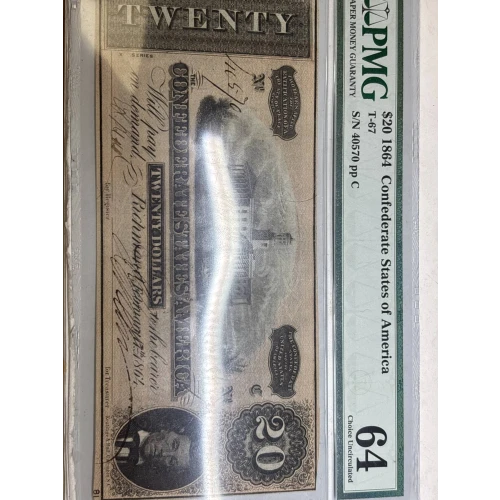
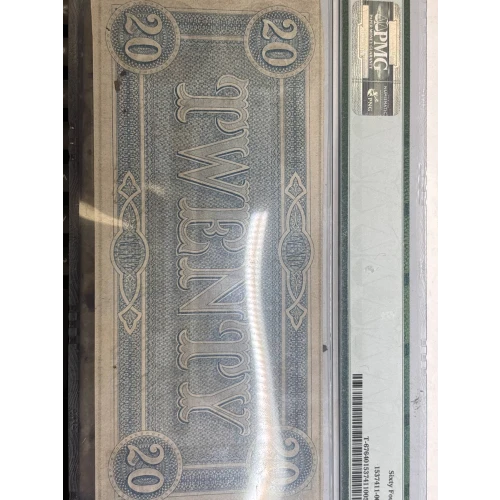
$20 Issues of the Confederate States of America CS-67

Collectible paper money from the United States represents a fascinating intersection of history, artistry, and numismatic value. American currency has evolved dramatically throughout the nation's history, with each era of paper money telling a unique story about the country's economic development, political leadership, and artistic achievement. Whether you're a seasoned numismatist, a history enthusiast, or someone looking to diversify their collection, United States collectible paper money offers exceptional value and historical significance.

United States currency has captivated collectors for generations. These tangible pieces of American history serve as windows into different periods of the nation's past, from the founding era through modern times. Collectors prize vintage and rare notes not only for their monetary worth but also for their historical importance and the craftsmanship displayed in their design and printing.

The History of United States Paper Money

The story of American paper currency is a complex and intriguing journey that spans centuries. While the federal government initially relied on coins and foreign currency for commerce, the need for a standardized paper money system became increasingly apparent as the nation grew. The first official U.S. paper currency wasn't issued until 1861, marking a pivotal moment in American financial history.

Before the Civil War, various private banks issued their own notes, creating a fragmented and often unreliable monetary system. These early notes, known as "broken bank notes," are highly sought after by collectors today due to their rarity and unique designs. The demand for a unified currency system led to the creation of the Demand Notes in 1861, which became the foundation for all subsequent U.S. paper money.

Major Eras of United States Paper Currency

Demand Notes (1861-1862)

  • First official U.S. paper money issued by the federal government
  • Printed in denominations of $5, $10, and $20
  • Featured the words "Demand Notes" prominently on the face
  • Issued to help finance the Civil War
  • Highly collectible due to their historical significance and limited quantities
  • Often command premium prices in the collectible market

Legal Tender Notes (1862-1923)

  • Extended timeframe of production spanning over 60 years
  • Available in denominations ranging from $1 to $500
  • Featured portraits of famous American historical figures
  • Issued in multiple series with varying designs and security features
  • Early issues from the 1860s and 1870s are particularly valuable
  • Often contain elaborate engravings and artistic elements

National Bank Notes (1863-1935)

  • Issued by individual national banks across the United States
  • Each note featured the name of the issuing bank
  • Available in over 12,000 different varieties
  • Denominations ranged from $1 to $100
  • Early notes printed from 1863-1875 are extremely valuable
  • Collectible based on rarity, condition, and bank location

Silver Certificates (1878-1964)

  • Backed by silver reserves held by the U.S. government
  • Distinguished by the phrase "Silver Certificate" printed on the note
  • Available in $1, $5, $10, $20, $50, and $100 denominations
  • Featured portraits of distinguished Americans including Martha Washington, Alexander Hamilton, and James Madison
  • Early issues from the 1880s-1890s are highly sought after
  • Later $1 Silver Certificates from the 1950s-1960s remain widely collected

Gold Certificates (1882-1933)

  • Represented a claim on gold bullion held by the Treasury
  • Printed with distinctive gold-colored ink on the reverse
  • Denominations included $10, $20, $50, $100, $500, $1,000, $5,000, and $10,000
  • Early series from 1882-1922 are particularly collectible
  • Production ceased with the Gold Reserve Act of 1933
  • Highly valued by collectors due to historical and monetary significance

Federal Reserve Notes (1914-Present)

  • Currently in circulation and serve as the official currency of the United States
  • First issued in 1914 to give the Federal Reserve control over the money supply
  • Denominations range from $1 to $100 in current circulation
  • Early notes from 1914-1920 are particularly collectible
  • Vintage issues and rare series commands premium values
  • Condition and rarity are key factors in determining collectible value

Years of Production and Availability

United States collectible paper money encompasses notes produced from 1861 through various modern eras. The earliest notes from the Civil War period (1861-1865) are among the most sought after by serious collectors. Notes from the 1870s-1890s represent a golden age of American currency design, featuring some of the most intricate and beautiful engravings ever created for U.S. currency.

The early 20th century (1900-1930) brought significant changes to American currency design and production. Notes from this period showcase the progression of printing technology and artistic evolution. Many collectors focus specifically on notes from the 1920s and 1930s, which represent the last era of large-sized currency before the government standardized smaller dimensions in 1929.

Post-World War II currency (1945-1970) remains highly collectible, particularly rare series and notes with unique serial numbers or printing varieties. Condition becomes increasingly important for notes from this era, as more specimens have survived in various states of preservation.

Design Elements and Artistic Features

American paper currency has always been more than just a medium of exchange—it's a canvas for some of the finest artistic and engraving work ever produced. Each note features portraits of important historical figures, allegorical representations of American values, and intricate border designs that showcase the skill of master engravers.

The portraits featured on U.S. currency have changed throughout history, reflecting the nation's evolving priorities and reverence for its leaders. Early notes featured presidents, founding fathers, and other notable Americans. The reverse sides of notes typically depicted scenes symbolic of American strength, liberty, or industry—from eagles and shields to symbolic representations of commerce and progress.

The security features incorporated into paper currency have also evolved significantly. Early notes relied primarily on intricate engraving work to prevent counterfeiting. Later issues introduced additional security measures including special inks, watermarks, and color-shifting features that make them more difficult to replicate.

Factors That Determine Collectible Value

Several key factors influence the value of collectible U.S. paper money in the marketplace. Understanding these elements can help collectors make informed decisions about acquisitions and appraisals.

Age and Historical Period

Generally, older notes command higher prices, particularly those from the 1860s-1890s. Notes from significant historical periods, such as those issued during the Civil War or early Federal Reserve era, tend to be more valuable than those from more recent decades.

Rarity and Availability

Scarce notes or those with limited surviving specimens are highly prized by collectors. Some series were printed in small quantities or many have been destroyed over time, making surviving examples increasingly valuable. Notes from failed banks or short-lived currency series are particularly rare.

Condition and Preservation

The physical state of a note dramatically affects its collectible value. Notes that have been preserved in excellent condition command significant premiums over those showing signs of wear, staining, or damage. Professional grading services assign numerical grades that help standardize value assessment across the market.

Serial Numbers and Printing Varieties

Certain serial numbers, such as those with special patterns or low numbers, can increase a note's value. Printing varieties—including different colored inks, overprints, or variations in design—create distinct subtypes that collectors seek to complete their collections.

Type and Denomination

Different types of notes (Legal Tender Notes, Silver Certificates, etc.) and specific denominations have varying collector appeal. Some denominations, particularly higher values like $500 and $1,000 notes, are rarer and more valuable due to limited circulation and survival rates.

Building a Collectible Paper Money Collection

Whether you're beginning your numismatic journey or expanding an existing collection, U.S. paper money offers opportunities for collectors at every level. Many collectors choose to focus on specific eras, such as Large Size Notes (1861-1929) or small-sized currency. Others prefer to collect by type, assembling examples of each major currency series issued by the United States.

Popular collecting strategies include acquiring one example of each design within a series, collecting by denomination, or focusing on notes from a specific geographic region—particularly for National Bank Notes, which vary considerably based on issuing institution.

The flexibility of paper money collecting means there are entry points for every budget. While rare Civil War-era notes or high-denomination Gold Certificates may command four or five-figure prices, affordable examples of later series remain accessible to new collectors without significant investment.

Authentication and Grading

Authentication and professional grading play crucial roles in the collectible currency market. Reputable third-party grading services examine notes for authenticity and assign grades based on established standards. This professional assessment protects collectors and helps ensure the reliability of the market.

Grading standards follow the Sheldon scale, with numerical ratings ranging from 1 (Poor) to 70 (Superb Gem Uncirculated). A note's grade directly correlates to its market value, making professional certification essential for significant acquisitions.

Investment Potential and Long-Term Value

Collectible U.S. paper money has demonstrated consistent appreciation over decades, making it attractive to investors as well as historians and enthusiasts. The combination of limited supply, enduring historical interest, and increasing collector demand supports long-term value growth.

Unlike stocks or bonds, tangible collectibles like vintage currency provide portfolio diversification and the personal satisfaction of owning significant pieces of American history. The global collector base ensures strong demand for quality specimens across all price ranges.

Why Collect United States Paper Money?

Collecting U.S. paper money offers unique advantages that appeal to diverse motivations. For history enthusiasts, each note represents a specific moment in American development. For numismatists, the technical aspects of currency design and production provide endless fascination. For investors, collectible currency offers tangible assets with proven appreciation potential.

The accessibility of paper money collecting—compared to rare coins or other collectibles—makes it an excellent entry point into numismatics. The visual appeal of currency design, combined with the educational value of understanding financial history, creates a rewarding hobby that can be enjoyed at any level of serious collecting.

United States collectible paper money represents the convergence of art, history, and commerce. Whether you seek a single cherished example from a significant historical period or aim to build a comprehensive collection spanning multiple eras, American currency offers exceptional opportunities for discovery and appreciation. These tangible records of the nation's financial evolution continue to captivate collectors worldwide and serve as enduring reminders of American heritage and achievement.

Product ID 561652
Series Year 1864
Country United States
Denomination $20
Grading Agency PMG
Grade 64
Signature -
Category Issues of the Confederate States of America
Serial No 40570
Status Active
Seal -
Fr / Pick # CS-67
Additional Info -

You must be authenticated to write reviews. Click here   to login.

There are no reviews yet. Be the first to write one!

1864 $20 Issues of the Confederate States of America CS-67 PMG 64

+

Description

Collectible paper money from the United States represents a fascinating intersection of history, artistry, and numismatic value. American currency has evolved dramatically throughout the nation's history, with each era of paper money telling a unique story about the country's economic development, political leadership, and artistic achievement. Whether you're a seasoned numismatist, a history enthusiast, or someone looking to diversify their collection, United States collectible paper money offers exceptional value and historical significance.

United States currency has captivated collectors for generations. These tangible pieces of American history serve as windows into different periods of the nation's past, from the founding era through modern times. Collectors prize vintage and rare notes not only for their monetary worth but also for their historical importance and the craftsmanship displayed in their design and printing.

The History of United States Paper Money

The story of American paper currency is a complex and intriguing journey that spans centuries. While the federal government initially relied on coins and foreign currency for commerce, the need for a standardized paper money system became increasingly apparent as the nation grew. The first official U.S. paper currency wasn't issued until 1861, marking a pivotal moment in American financial history.

Before the Civil War, various private banks issued their own notes, creating a fragmented and often unreliable monetary system. These early notes, known as "broken bank notes," are highly sought after by collectors today due to their rarity and unique designs. The demand for a unified currency system led to the creation of the Demand Notes in 1861, which became the foundation for all subsequent U.S. paper money.

Major Eras of United States Paper Currency

Demand Notes (1861-1862)

  • First official U.S. paper money issued by the federal government
  • Printed in denominations of $5, $10, and $20
  • Featured the words "Demand Notes" prominently on the face
  • Issued to help finance the Civil War
  • Highly collectible due to their historical significance and limited quantities
  • Often command premium prices in the collectible market

Legal Tender Notes (1862-1923)

  • Extended timeframe of production spanning over 60 years
  • Available in denominations ranging from $1 to $500
  • Featured portraits of famous American historical figures
  • Issued in multiple series with varying designs and security features
  • Early issues from the 1860s and 1870s are particularly valuable
  • Often contain elaborate engravings and artistic elements

National Bank Notes (1863-1935)

  • Issued by individual national banks across the United States
  • Each note featured the name of the issuing bank
  • Available in over 12,000 different varieties
  • Denominations ranged from $1 to $100
  • Early notes printed from 1863-1875 are extremely valuable
  • Collectible based on rarity, condition, and bank location

Silver Certificates (1878-1964)

  • Backed by silver reserves held by the U.S. government
  • Distinguished by the phrase "Silver Certificate" printed on the note
  • Available in $1, $5, $10, $20, $50, and $100 denominations
  • Featured portraits of distinguished Americans including Martha Washington, Alexander Hamilton, and James Madison
  • Early issues from the 1880s-1890s are highly sought after
  • Later $1 Silver Certificates from the 1950s-1960s remain widely collected

Gold Certificates (1882-1933)

  • Represented a claim on gold bullion held by the Treasury
  • Printed with distinctive gold-colored ink on the reverse
  • Denominations included $10, $20, $50, $100, $500, $1,000, $5,000, and $10,000
  • Early series from 1882-1922 are particularly collectible
  • Production ceased with the Gold Reserve Act of 1933
  • Highly valued by collectors due to historical and monetary significance

Federal Reserve Notes (1914-Present)

  • Currently in circulation and serve as the official currency of the United States
  • First issued in 1914 to give the Federal Reserve control over the money supply
  • Denominations range from $1 to $100 in current circulation
  • Early notes from 1914-1920 are particularly collectible
  • Vintage issues and rare series commands premium values
  • Condition and rarity are key factors in determining collectible value

Years of Production and Availability

United States collectible paper money encompasses notes produced from 1861 through various modern eras. The earliest notes from the Civil War period (1861-1865) are among the most sought after by serious collectors. Notes from the 1870s-1890s represent a golden age of American currency design, featuring some of the most intricate and beautiful engravings ever created for U.S. currency.

The early 20th century (1900-1930) brought significant changes to American currency design and production. Notes from this period showcase the progression of printing technology and artistic evolution. Many collectors focus specifically on notes from the 1920s and 1930s, which represent the last era of large-sized currency before the government standardized smaller dimensions in 1929.

Post-World War II currency (1945-1970) remains highly collectible, particularly rare series and notes with unique serial numbers or printing varieties. Condition becomes increasingly important for notes from this era, as more specimens have survived in various states of preservation.

Design Elements and Artistic Features

American paper currency has always been more than just a medium of exchange—it's a canvas for some of the finest artistic and engraving work ever produced. Each note features portraits of important historical figures, allegorical representations of American values, and intricate border designs that showcase the skill of master engravers.

The portraits featured on U.S. currency have changed throughout history, reflecting the nation's evolving priorities and reverence for its leaders. Early notes featured presidents, founding fathers, and other notable Americans. The reverse sides of notes typically depicted scenes symbolic of American strength, liberty, or industry—from eagles and shields to symbolic representations of commerce and progress.

The security features incorporated into paper currency have also evolved significantly. Early notes relied primarily on intricate engraving work to prevent counterfeiting. Later issues introduced additional security measures including special inks, watermarks, and color-shifting features that make them more difficult to replicate.

Factors That Determine Collectible Value

Several key factors influence the value of collectible U.S. paper money in the marketplace. Understanding these elements can help collectors make informed decisions about acquisitions and appraisals.

Age and Historical Period

Generally, older notes command higher prices, particularly those from the 1860s-1890s. Notes from significant historical periods, such as those issued during the Civil War or early Federal Reserve era, tend to be more valuable than those from more recent decades.

Rarity and Availability

Scarce notes or those with limited surviving specimens are highly prized by collectors. Some series were printed in small quantities or many have been destroyed over time, making surviving examples increasingly valuable. Notes from failed banks or short-lived currency series are particularly rare.

Condition and Preservation

The physical state of a note dramatically affects its collectible value. Notes that have been preserved in excellent condition command significant premiums over those showing signs of wear, staining, or damage. Professional grading services assign numerical grades that help standardize value assessment across the market.

Serial Numbers and Printing Varieties

Certain serial numbers, such as those with special patterns or low numbers, can increase a note's value. Printing varieties—including different colored inks, overprints, or variations in design—create distinct subtypes that collectors seek to complete their collections.

Type and Denomination

Different types of notes (Legal Tender Notes, Silver Certificates, etc.) and specific denominations have varying collector appeal. Some denominations, particularly higher values like $500 and $1,000 notes, are rarer and more valuable due to limited circulation and survival rates.

Building a Collectible Paper Money Collection

Whether you're beginning your numismatic journey or expanding an existing collection, U.S. paper money offers opportunities for collectors at every level. Many collectors choose to focus on specific eras, such as Large Size Notes (1861-1929) or small-sized currency. Others prefer to collect by type, assembling examples of each major currency series issued by the United States.

Popular collecting strategies include acquiring one example of each design within a series, collecting by denomination, or focusing on notes from a specific geographic region—particularly for National Bank Notes, which vary considerably based on issuing institution.

The flexibility of paper money collecting means there are entry points for every budget. While rare Civil War-era notes or high-denomination Gold Certificates may command four or five-figure prices, affordable examples of later series remain accessible to new collectors without significant investment.

Authentication and Grading

Authentication and professional grading play crucial roles in the collectible currency market. Reputable third-party grading services examine notes for authenticity and assign grades based on established standards. This professional assessment protects collectors and helps ensure the reliability of the market.

Grading standards follow the Sheldon scale, with numerical ratings ranging from 1 (Poor) to 70 (Superb Gem Uncirculated). A note's grade directly correlates to its market value, making professional certification essential for significant acquisitions.

Investment Potential and Long-Term Value

Collectible U.S. paper money has demonstrated consistent appreciation over decades, making it attractive to investors as well as historians and enthusiasts. The combination of limited supply, enduring historical interest, and increasing collector demand supports long-term value growth.

Unlike stocks or bonds, tangible collectibles like vintage currency provide portfolio diversification and the personal satisfaction of owning significant pieces of American history. The global collector base ensures strong demand for quality specimens across all price ranges.

Why Collect United States Paper Money?

Collecting U.S. paper money offers unique advantages that appeal to diverse motivations. For history enthusiasts, each note represents a specific moment in American development. For numismatists, the technical aspects of currency design and production provide endless fascination. For investors, collectible currency offers tangible assets with proven appreciation potential.

The accessibility of paper money collecting—compared to rare coins or other collectibles—makes it an excellent entry point into numismatics. The visual appeal of currency design, combined with the educational value of understanding financial history, creates a rewarding hobby that can be enjoyed at any level of serious collecting.

United States collectible paper money represents the convergence of art, history, and commerce. Whether you seek a single cherished example from a significant historical period or aim to build a comprehensive collection spanning multiple eras, American currency offers exceptional opportunities for discovery and appreciation. These tangible records of the nation's financial evolution continue to captivate collectors worldwide and serve as enduring reminders of American heritage and achievement.

Specifications

Secure Transactions
Safeguarding Your Investments/Passion in Coins, Currency, or Bullion
We Buy Estates
We buy in-whole or in-part estates in 7 a state area.
Cash for Gold
Convert unwanted jewelry to cash or bullion
Your Cart


Continue to Checkout